 Sanmi Dawodu

Build Consistency in Your Growth God’s Way
If you have ever asked yourself how to build consistency in your personal growth as a Christian, you are not alone — and you are asking the right question. Not the motivational-poster version of the question, but the honest, gritty one: How do I actually keep going when life crowds in, my energy runs out, and I cannot see anything changing? That tension is real, and it deserves a real answer.
Here is what most personal growth content will not tell you: consistency is not primarily a willpower problem. It is a worship problem. When we treat daily faithfulness as merely a productivity strategy, we strip it of its deepest meaning. But when we understand that showing up — quietly, repeatedly, without fanfare — is itself an act of covenant obedience, everything shifts. You are not grinding toward a better version of yourself. You are stewarding the life God has entrusted to you, one faithful day at a time.
This article is going to show you how to build that kind of consistency — not through hype, but through biblical truth and practical structure.
Why Consistency Feels So Difficult (And Why That Is Not the Whole Story)
Consistency is hard because growth is slow. The human brain is wired to respond to immediate rewards, and spiritual maturity rarely offers them. You read your Bible this morning, and nothing dramatic happened. You prayed, and the ceiling felt low. You chose patience in a difficult conversation, and nobody noticed. This is where most people abandon the process — not because they stopped caring, but because the feedback loop is invisible.
Scripture, however, tells a different story about invisible progress. Galatians 6:9 says, “And let us not be weary in well doing: for in due season we shall reap, if we faint not.” The word due season implies a harvest that is already calendared in heaven — it simply has not arrived yet on earth. Your faithfulness is never wasted. It is being counted.
The other reason consistency collapses is that we have built it on the wrong foundation. Motivation is a feeling, and feelings fluctuate. Discipline is a decision, and decisions can be anchored to something deeper than mood. Understanding what true consistency looks like for a Christian begins with detaching the practice from emotional momentum and attaching it instead to purpose and covenant.
Reframing Consistency as Covenant Practice
In the Old Testament, covenant was not a one-time event — it was a way of life. Abraham did not just receive the promise; he walked before God daily in its light. The priests did not sacrifice once and call it done; the offering was morning and evening, day after day. That rhythm was not repetition for its own sake. It was faithfulness made visible.
Your daily growth habits work the same way. When you choose to open your Bible before your phone, that small act declares something about who you belong to. When you journal your prayers instead of spiraling in anxiety, you are practicing trust. These are not self-improvement techniques — they are liturgies of surrender.
Growing spiritually through consistency means understanding that the process itself is the point. God is not waiting for you to arrive at some finished, polished version of yourself. He is present in the daily walk — forming character, deepening faith, and building capacity for greater Kingdom assignment through the very act of repeated faithfulness.
How to Build Consistency in Your Personal Growth as a Christian: A Practical Framework
Principles matter, but so does structure. Here is a practical, biblically-grounded framework you can begin applying this week.
1. Start With Why, Not What
Before you build a routine, clarify your motivation. Not vague spiritual goals, but honest answers. Why do you want to grow? What does God seem to be calling you toward in this season? When your consistency is anchored to a clear sense of Kingdom purpose, it becomes harder to abandon when things get difficult. Write it down. Revisit it regularly. Let it function as your compass on low-motivation days.
2. Build a Morning Anchor
The way you begin your day sets the tone for everything that follows. Building a disciplined morning routine as a Christian does not require waking at 4 a.m. or spending three hours in prayer. It requires intentionality. Even 20 focused minutes of Scripture reading and honest prayer before the noise of the day begins is a powerful anchor. Psalm 5:3 captures the posture well: “My voice shalt thou hear in the morning, O LORD; in the morning will I direct my prayer unto thee, and will look up.”
Research from the American Psychological Association on habit formation consistently shows that linking new behaviors to existing anchors — especially morning routines — significantly improves long-term consistency. This is not just psychology; it is wisdom the Bible anticipated.
3. Choose Disciplines That Fit Your Actual Life
One of the fastest ways to kill consistency is choosing a growth plan designed for someone else’s life. Spiritual disciplines that actually stick are ones that are honest about your current season, capacity, and temperament. A parent of young children cannot maintain the same schedule as a single professional — and God is not asking them to. He is asking for faithfulness within the actual life they have.
Start smaller than you think you need to. Five minutes of focused Bible reading done daily beats one dramatic two-hour session followed by two weeks of absence. Consistency always outperforms intensity over time.
4. Build In Accountability Without Performance
Proverbs 27:17 tells us, “Iron sharpeneth iron; so a man sharpeneth the countenance of his friend.” You were not designed to grow alone. Find one or two people who can speak honestly into your life — not to grade your performance, but to walk with you in genuine Christian fellowship. This kind of accountability is not about shame; it is about shared commitment to becoming who God has called you both to be.
Studies from the Society for Personality and Social Psychology have found that sharing specific goals with a committed accountability partner measurably increases follow-through. God designed community before science described it.
5. Treat Failure as Data, Not Verdict
You will miss days. There will be weeks that go sideways. This is not evidence that consistency is beyond you — it is evidence that you are human. The question is never whether you stumble; it is whether you get back up. Staying consistent in your spiritual life across the long arc of your journey requires a theology of recovery, not just a theology of performance.
Micah 7:8 says, “Rejoice not against me, O mine enemy: when I fall, I shall arise; when I sit in darkness, the LORD shall be a light unto me.” Rising is built into the covenant. Make it part of your growth plan.
6. Review and Realign Regularly
Monthly or quarterly, take time to honestly assess your growth. Not with harsh criticism, but with the same compassion God offers you. What is working? What has quietly slipped? Where is God inviting you to go deeper? Daily Christian discipline is strengthened by periodic review, the same way a ship regularly checks its navigation rather than assuming the initial heading is still accurate.
When Growth Feels Invisible: Staying Faithful in the Slow Seasons
Some seasons of growth are quiet to the point of feeling absent. You are doing the work, but nothing seems to be moving. This is where many believers conclude that God is silent or that growth has stalled. In reality, these seasons are often where the deepest formation happens — beneath the surface, out of sight.
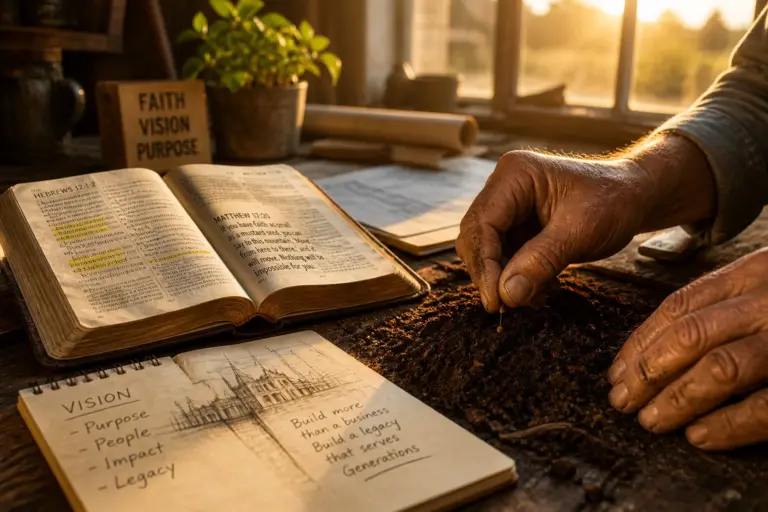
Keeping going when progress feels slow spiritually requires trusting what you know over what you feel. You know God is faithful (1 Corinthians 1:9). You know his Word does not return void (Isaiah 55:11). You know that the farmer does not dig up the seed to check on it; he tends the soil and trusts the harvest.
The epistle of James reminds us that the testing of our faith works patience — and patience, fully formed, leaves nothing lacking. Invisible seasons are not wasted seasons. They are where endurance is built.
A Practical Weekly Action Plan
- Monday: Set your weekly growth intention in writing. One spiritual focus, one practical habit to strengthen.
- Tuesday–Thursday: Show up for your anchor habits without negotiating. Bible, prayer, and one growth-related action daily.
- Friday: Check in with your accountability partner. Brief, honest, specific.
- Saturday: Rest and reflect. Journal what you noticed God doing in the week, even if it was small.
- Sunday: Worship with community. Let corporate faith refuel individual faithfulness.
According to Johns Hopkins Medicine research on healthy habit formation, consistent weekly rhythms — rather than sporadic intensive effort — produce the most durable behavioral change. Scripture echoes this in the wisdom literature repeatedly: small, steady faithfulness is the architecture of a well-built life.
Consistency Is Worship
Let this truth settle in you before we close. Every morning you choose growth over comfort, you are worshipping. Every time you return to the Word when it would be easier to scroll, you are worshipping. Every moment you choose patience, honesty, or courage in a small situation, you are partnering with God in the slow, magnificent work of Kingdom advancement — beginning in you.
Learning how to build consistency in your personal growth as a Christian is not about becoming a disciplined machine. It is about becoming a faithful steward — someone whose daily life says, I trust you, Lord, with every ordinary moment. That is a powerful thing. And it compounds.
Frequently Asked Questions
Why is consistency in personal growth so difficult for Christians, and what does the Bible say about it?
Consistency is difficult because spiritual growth is slow, invisible in the short term, and runs directly against the grain of a culture built on instant results. Add to that the reality of spiritual opposition — “Be sober, be vigilant; because your adversary the devil, as a roaring lion, walketh about, seeking whom he may devour” (1 Peter 5:8) — and you have a genuine battle to maintain forward movement. The Bible does not pretend this is easy. It repeatedly calls believers to endurance, longsuffering, and perseverance — words that only make sense if the journey is genuinely hard. What Scripture promises is not that it will feel easy, but that faithful effort is never wasted and that God himself is at work in the process: “Being confident of this very thing, that he which hath begun a good work in you will perform it until the day of Jesus Christ” (Philippians 1:6).
What daily spiritual habits actually build long-term consistency in a Christian’s personal growth?
The habits that build lasting consistency are simple, repeatable, and tethered to a clear sense of purpose. Daily Scripture engagement — even short and focused — keeps your mind renewed and your values aligned. Honest, conversational prayer builds intimacy with God that sustains you through dry seasons. Journaling helps you track invisible progress and recognize patterns of growth. Serving others regularly grounds your growth in love rather than self-focus. And weekly worship with a faith community provides the relational fuel that solo effort cannot generate. None of these need to be lengthy or elaborate. What matters is that they are consistent. Romans 12:2 frames this beautifully: transformation comes through the renewing of the mind — a daily, ongoing process, not a single dramatic event.
How do I stay consistent in growing personally when I feel stuck, burned out, or like God is silent?
First, acknowledge honestly what you are experiencing. Spiritual burnout is real, and pretending it is not only deepens the disconnection. Many of the Psalms model this kind of raw honesty before God — Psalm 13 and Psalm 22 both begin in apparent abandonment and move toward trust. Second, lower the bar without abandoning the practice. On hard days, your only job is to show up — even briefly, even imperfectly. Third, lean on your community. Isolation amplifies discouragement; connection restores perspective. Fourth, remember that silence is not absence. God’s work in you during quiet seasons is often the most formative. The farmer does not see the seed germinating underground, but the growth is happening. Trust the process you have been faithful to, rest in the faithfulness of the God who called you, and take the next small step. That is enough.