 Sanmi Dawodu

Patient Faith: When God’s Timing Feels Slow
You are praying. You are reading your Bible. You are showing up on Sunday, serving in your community, guarding your heart, doing the work. And yet — nothing seems to be moving. The relationship is still broken. The finances have not turned around. The calling you feel so certain about has not opened a single door. If you have ever sat in that silence and wondered whether God is paying attention, you are not alone, and you are not failing. The question of how to be patient with slow spiritual progress is one of the most honest questions a believer can ask, because slow seasons have a way of making faithfulness feel pointless.
This article is written for you — the one doing everything right and still waiting. Not to offer easy comfort or hollow promises, but to reframe the waiting itself so that it becomes something purposeful rather than merely painful.
The Problem With How We Define Progress
Most of us measure spiritual progress the same way we measure almost everything else: by visible results. Did the prayer get answered? Did the situation change? Did the number go up? This is understandable. We are wired to notice outcomes. But the Kingdom of God does not always operate on that timeline, and the gap between our expectation and our experience is where a great deal of unnecessary suffering is created.
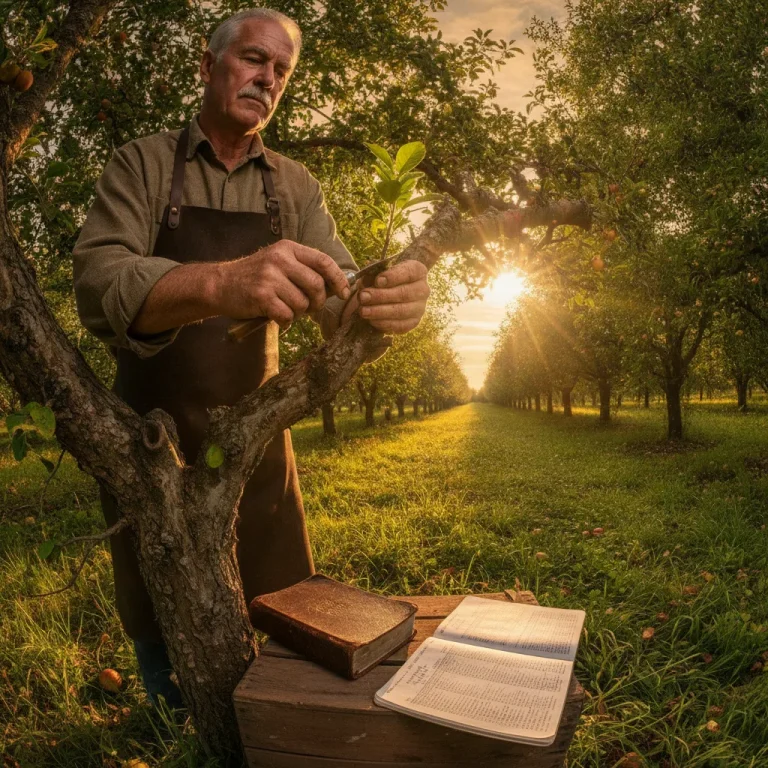
Jesus himself used agricultural language repeatedly to describe how the Kingdom works. Seeds. Soil. Harvest. None of those images are about instant results. They are about processes that unfold beneath the surface, invisibly, over time — and that only become visible when the season is right. The farmer does not dig up the seed every morning to check whether it has grown. He trusts the process and keeps tending the field.
That is not passive resignation. That is disciplined, active faith.
What Galatians 6:9 Actually Promises
The apostle Paul writes in Galatians 6:9, “And let us not be weary in well doing: for in due season we shall reap, if we faint not.” Read that carefully. There are three load-bearing phrases in that single verse.
- “Let us not be weary in well doing” — The warning is against weariness, not against slowness. Paul acknowledges that the right actions can still feel exhausting when results are delayed. He is not telling you the delay is not real. He is telling you how to respond to it.
- “In due season” — Not your season. Not the season you planned for. The season that is due. There is a harvest appointed, and its timing belongs to God, not to your calendar.
- “If we faint not” — The conditional is not about perfection. It is about continuity. The harvest is not withheld from those who perform flawlessly. It is lost by those who stop before the season arrives.
This passage is not a vague encouragement. It is a structured promise with a clear condition: keep going. If you are in a slow season right now, this verse is not just comfort — it is instruction.
Unseen Growth Is Still Real Growth
One of the most important things you can settle in your spirit is this: the absence of visible fruit does not mean the absence of real work. When a seed is underground, nothing looks different from the surface. But beneath the soil, everything is happening — root systems are forming, nutrients are being absorbed, structure is being built that will eventually hold the weight of a full harvest.
Your character is being formed in the waiting. Your endurance is being tested and strengthened. Your dependence on God is being deepened in ways that a quick answer would never have produced. None of this shows up on a dashboard. But it is entirely real, and it is entirely valuable.
If you are wrestling with this kind of invisible growth, this piece on Christian resilience when progress feels slow goes deeper into how to hold steady when external circumstances refuse to confirm what you are doing internally.
Active Faithfulness: What Patience Actually Looks Like
Biblical patience is not sitting still. It is not passively enduring. The Greek word used in the New Testament for this kind of patience — hupomone — literally means “to remain under.” It pictures someone who is carrying a heavy load and choosing not to put it down. That is active. That is muscular. That is a choice made again and again, day after day.
Hebrews 6:12 calls us to be “followers of them who through faith and patience inherit the promises.” Notice the pairing: faith and patience together. Neither one alone is sufficient. Faith without patience collapses the moment the timeline does not cooperate. Patience without faith becomes mere stoicism — enduring without expectation. Together, they constitute what the Bible calls perseverance, and perseverance is one of the most significant markers of mature Christian character.
For a practical look at what this kind of active, continuing faithfulness looks like day to day, see this guide on how to keep going when progress feels slow spiritually.
How to Be Patient With Slow Spiritual Progress: A Practical Daily Framework
Knowing that patience is active is one thing. Knowing what to do with a Tuesday morning when nothing has changed is another. Here is a practical framework built around the principle of sowing faithfully regardless of visible harvest.
1. Anchor Your Identity to Calling, Not Results
The moment your sense of worth and direction becomes tied to outcomes, slow seasons become identity crises. Return regularly to the question: What has God called me to do right now? Faithfulness to that call — regardless of what it produces — is the assignment. The results are God’s department.
2. Keep a Faithfulness Record, Not a Results Record
Instead of tracking what has changed, start tracking what you have done. Did you pray today? Did you serve faithfully? Did you resist the temptation to quit? These are not small things. Over time, a faithfulness record becomes evidence — to your own heart — that you are not standing still, even when the external picture says otherwise.
3. Protect Your Input Sources
What you consume during a waiting season shapes how you interpret it. If your primary inputs are anxiety-producing, comparison-driven, or focused entirely on outcomes, your endurance will erode. Prioritise Scripture, sound teaching, and community with people who are themselves anchored in God’s faithfulness. This is not about information management — it is about spiritual survival.
4. Build Repeatable Daily Rhythms
Motivation is not reliable enough to carry you through a long wait. Discipline is. Build daily rhythms of prayer, Scripture, and accountability that run on commitment rather than feeling. On the days when you cannot feel God’s presence, your rhythms carry you until the feeling returns. For help building habits that actually last, this resource on how to build spiritual disciplines that stick is a useful starting point.
5. Serve Beyond Your Own Situation
One of the most effective antidotes to the tunnel vision of a difficult season is outward-focused service. When you are active in blessing others, your own waiting becomes less consuming. It does not solve the problem, but it reorients your attention from what God has not yet done for you to what God is doing through you — and that shift matters enormously.
6. Return to Surrender Regularly
Surrender is not a one-time event. For most believers in a slow season, it is a daily — sometimes hourly — practice. The prayer “not my will, but thine, be done” (Luke 22:42) was not easy for Jesus to pray, and it will not be easy for you either. But it is the prayer that aligns your timeline with God’s, and it is the posture from which perseverance becomes sustainable.
For more on navigating uncertainty without losing your footing, this article on how to trust God when you don’t know what’s next addresses the specific tension of forward movement when the path is unclear.
When the Wait Feels Like Abandonment
There is a difference between a slow season and a sense that God has gone silent. If your waiting has started to feel less like a field in winter and more like a forgotten room, it is worth naming that honestly before God. The Psalms are full of this kind of lament — Psalm 13:1 opens with “How long wilt thou forget me, O LORD? for ever?” — and God did not rebuke David for asking it. He received it.
Lament is not unbelief. Lament is faith crying out loud. It is bringing your honest experience before the One you believe is actually listening, even when the evidence feels thin. This is part of what Romans 8:26 means when it tells us the Spirit intercedes for us with groanings that cannot be uttered. God is not unaware of what you cannot even find words to pray.
The Christianity Today resource on patience in the Christian life offers additional theological grounding on why waiting is woven into the fabric of Christian formation rather than being an interruption to it.
What the Biblical Record Shows About Long Waits
Abraham waited twenty-five years between the promise of a son and the birth of Isaac. Joseph spent years in a pit and then a prison before the dream God gave him became reality. Moses was in the wilderness for forty years before God called him to lead the Exodus. None of these men were waiting because they lacked faith. They were waiting because the fullness of what God intended required a preparation that could not be shortcut.
This does not mean every long wait leads to a dramatic reversal. But it does mean that long waits are not aberrations in God’s economy. They are features. The biblical case for waiting on God is far richer and more specific than popular Christianity often communicates.
You can also find encouragement in the way Scripture frames uncertain seasons in this article on how to trust God in uncertain seasons, which speaks directly to the experience of being between a promise and its fulfilment.
Staying Motivated When the Results Don’t Come
Motivation is a finite resource when it is fed only by results. But when motivation is anchored in something larger — in obedience, in calling, in the character of God — it becomes renewable. You are not persevering to earn the harvest. You are persevering because you believe the One who promised it is faithful. That is a fundamentally different engine.
For practical strategies on maintaining spiritual motivation across long seasons, this guide on how to stay motivated as a Christian daily and this companion piece on how to be consistent in personal growth as a Christian offer concrete daily approaches that do not depend on emotional momentum to sustain them.
The Desiring God collection on patience is also an excellent resource for deeper theological reading on what it means to wait well.
A Strong Conclusion: Keep Sowing
Understanding how to be patient with slow spiritual progress begins with one honest reframe: you are not waiting for God to start working. You are working alongside a God who is already at work in ways you cannot yet see. The seed you sow today — in prayer, in faithfulness, in service, in obedience — does not disappear simply because you cannot see it sprouting. It goes into ground that God has prepared, and the harvest will come in its season.
Do not faint. Do not quit the field. Do not trade your long-term inheritance for the short-term relief of giving up. The farmer who keeps tending his field through winter is not naive — he is wise. He knows that the harvest does not ask the farmer’s permission to arrive. It simply comes when the season is due.
Your season is due. Keep sowing.
Frequently Asked Questions
What does the Bible say about waiting patiently for God’s timing?
Scripture returns to this theme repeatedly and consistently. Psalm 27:14 instructs, “Wait on the LORD: be of good courage, and he shall strengthen thine heart: wait, I say, on the LORD.” Isaiah 40:31 promises that those who wait on the Lord will renew their strength. Hebrews 10:36 states, “For ye have need of patience, that, after ye have done the will of God, ye might receive the promise.” The biblical picture of waiting is never passive or resigned — it is expectant, active, and anchored in the character of a God who does not forget his people. For a broader look at what Scripture says about this, the full text of Isaiah 40:31 is worth reading in context.