| |

How to Pray Effectively: The Ultimate Biblical Guide | Sanmi Dawodu Ministries

Discover how to pray effectively with this ultimate biblical guide. Learn the Lord’s Prayer model, ACTS framework, praying with faith, persistent prayer, praying in the Spirit, and how to overcome every obstacle to powerful prayer.

How to Pray Effectively (Ultimate Biblical Guide)
How to Pray Effectively: The Ultimate Biblical Guide | Sanmi Dawodu Ministries
Spiritual Growth · Prayer Guide

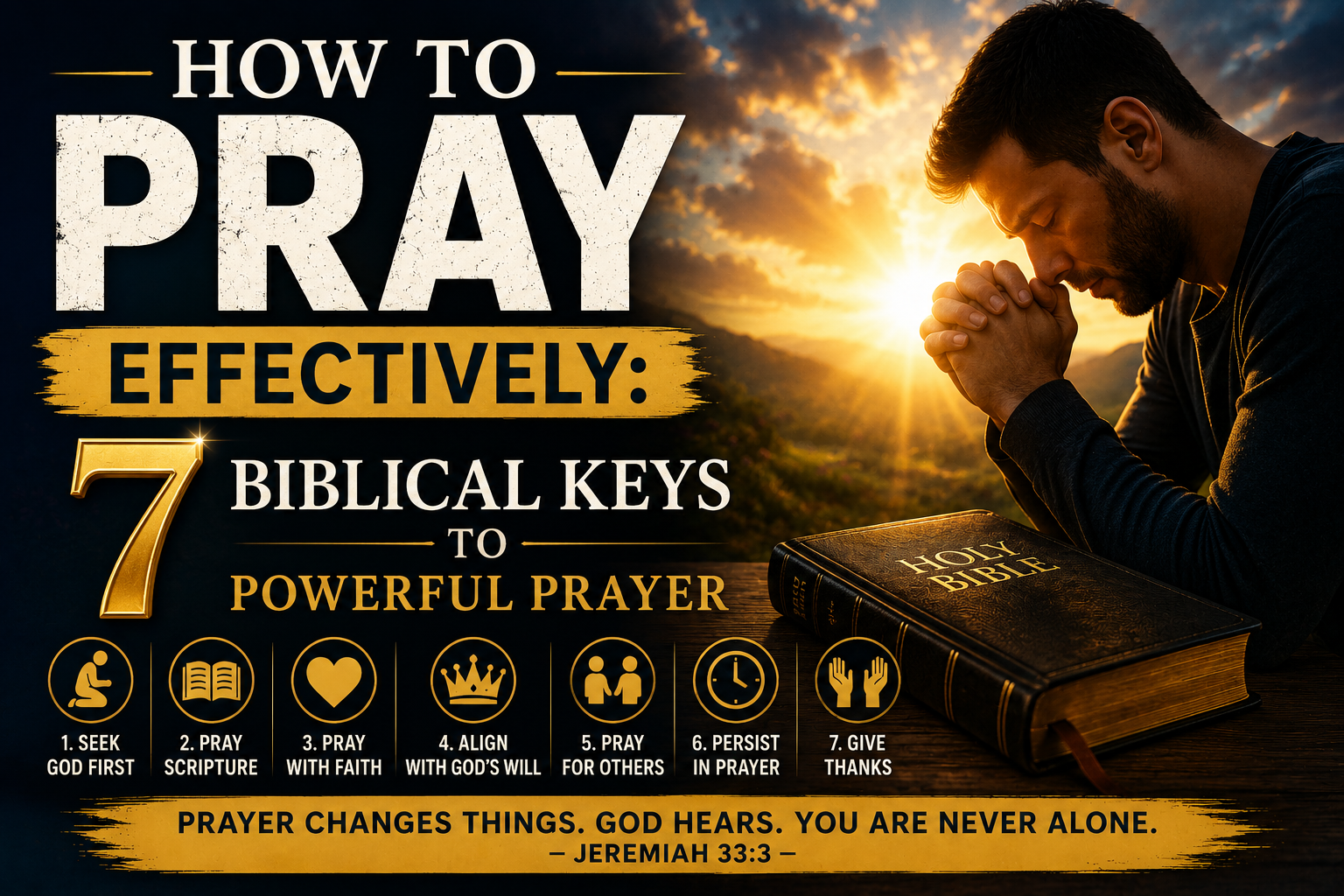
How to Pray Effectively: The Ultimate Biblical Guide

"The effective, fervent prayer of a righteous man avails much."

📅 April 25, 2026 ✍ Sanmi Dawodu Ministries 📖 James 5:16 (NKJV)

What makes prayer effective according to the Bible?

According to James 5:16, effective prayer is fervent, faith-filled, and offered by a righteous person. The Bible gives six marks of prayer that truly works:

  • Pray in faith — without doubting, believing God hears and answers (James 1:6-7)
  • Pray in Jesus' name — coming to the Father through the only Mediator (John 14:13-14)
  • Pray according to God's will — aligning requests with His Word and purposes (1 John 5:14-15)
  • Pray with a clean heart — unconfessed sin breaks the connection (Psalm 66:18)
  • Pray persistently — Jesus commanded always praying and not losing heart (Luke 18:1)
  • Pray in the Spirit — the Holy Spirit helps where our words and knowledge run out (Romans 8:26-27)

Key Scripture: James 5:16"The effective, fervent prayer of a righteous man avails much."

If you're searching for how to pray effectively, you are not alone — and you are asking exactly the right question. The disciples asked it too: "Lord, teach us to pray" (Luke 11:1). This guide is Jesus' answer — made comprehensive, practical, and Spirit-empowered for every believer.

What Is Prayer? A Biblical Foundation

Before learning how to pray effectively, it is essential to understand what prayer actually is. Many believers approach prayer as a religious obligation — a spiritual discipline to check off the daily list. Others treat it as an emergency hotline, activated only when things go wrong. The Bible presents something far richer and more relational.

Prayer is communion with God — two-way communication between a child and their Father, rooted in covenant relationship made possible through the blood of Jesus Christ. It is not primarily a technique; it is a relationship. Hebrews 4:16 invites every believer to "come boldly to the throne of grace, that we may obtain mercy and find grace to help in time of need." The throne room of God is not an intimidating courtroom — it is a place of access, intimacy, and help.

Paul's instruction to "pray without ceasing" in 1 Thessalonians 5:17 is not a command to be perpetually on your knees. It is a call to a continuous internal orientation toward God — a life where prayer is less an isolated appointment and more a sustained conversation woven through every moment.

The foundational truth: You already have access. The veil that once separated sinful humanity from the holy presence of God was torn — permanently — at the moment of Christ's death (Matthew 27:51). Every effective prayer you pray begins from this side of that torn veil.

The Lord's Prayer: Jesus' Model Unpacked (Matthew 6:9-13)

When the disciples asked Jesus to teach them to pray, He gave them not a list of techniques but a model — a template that maps the entire territory of prayer in six movements. In Matthew 6:9-13, Jesus said: "In this manner, therefore, pray." The word "manner" is critical — He was giving a pattern, not a script to repeat mechanically.

"Our Father in heaven, Hallowed be Your name. Your kingdom come. Your will be done on earth as it is in heaven. Give us this day our daily bread. And forgive us our debts, as we forgive our debtors. And do not lead us into temptation, but deliver us from the evil one. For Yours is the kingdom and the power and the glory forever. Amen."

Matthew 6:9-13 (NKJV)

Movement 1: "Our Father in heaven" — Relationship Before Request

Jesus begins not with a need but with a relationship. "Our Father" establishes the identity of the one you are praying to and the identity of the one praying. You are not a beggar at a stranger's door — you are a child coming to a Father. This relational foundation changes the entire atmosphere of prayer. Every effective prayer session should begin by consciously entering the Father's presence and orienting yourself to who He is.

Movement 2: "Hallowed be Your name" — Worship Before Petition

"Hallowed" — set apart as holy — is the posture of adoration. Before you bring a single request, you magnify the name of God. This is not religious formality; it is the reorientation of your soul from the noise of your circumstances to the greatness of the God who governs them. Worship recalibrates faith. It reminds you of who is answering your prayers before you articulate what they are.

Movement 3: "Your kingdom come, Your will be done" — Submission Before Supply

The most misunderstood phrase in all of prayer. Many believers quote "Your will be done" as resignation — as if God's will is an inscrutable override that makes their prayer pointless. But in context, this is a battle cry. It is the declaration that the believer's prayers are aligned with advancing God's kingdom and His purposes, not merely personal comfort. It is the posture of the intercessor who says: I am praying for what You want, not merely what I want.

Movement 4: "Give us this day our daily bread" — Dependence on God's Provision

After relationship, worship, and submission — now come the requests. And notably, Jesus begins with daily, practical provision. God is interested in the bread you will eat today, not only in the grand theological categories of your life. Effective prayer is specific and daily — not a vague "bless me" but an articulate "I need this today."

Movement 5: "Forgive us our debts, as we forgive our debtors" — Cleansing the Channel

Jesus links receiving God's forgiveness with extending forgiveness to others. This is not transactional — it is diagnostic. A heart that cannot forgive has not fully received the grace of being forgiven. Unresolved unforgiveness is one of the most common obstacles to effective prayer. This movement of the Lord's Prayer is an invitation to keep the channel clear.

Movement 6: "Deliver us from the evil one" — Warfare in Prayer

Effective prayer includes spiritual warfare — asking God's protection against the adversary who seeks to steal, kill, and destroy (John 10:10). The believer who never prays for deliverance is fighting in a battle they have not acknowledged. Jesus built this dimension into the foundational prayer template.

The ACTS Prayer Model: How to Structure Every Prayer Session

The ACTS framework (Adoration, Confession, Thanksgiving, Supplication) is one of the most practically useful prayer structures ever developed — and every element is rooted in Scripture. It mirrors the flow of the Lord's Prayer and ensures that prayer is not reduced to a wish list.

A
Adoration
Praise God for who He is — His nature, names, and attributes. Begin here before anything else.
C
Confession
Bring every known sin before God honestly. Receive His forgiveness and clear the channel.
T
Thanksgiving
Thank God specifically for what He has done — answered prayers, provision, mercy, grace.
S
Supplication
Now bring your requests — personal, intercessory, for the church, the lost, and the world.

The wisdom of ACTS is in its order. When you begin with Adoration, you are not warming up to prayer — you are entering the environment where prayer is most potent. Faith rises in the atmosphere of worship. Confession removes what hinders. Thanksgiving cultivates expectation. And Supplication — now positioned last — comes from a place of aligned, faith-filled, cleansed, grateful asking.

"Most ineffective prayer is prayer that goes straight to S — Supplication — without passing through A, C, and T. The sequence is not incidental. Each movement prepares the heart for the next."

How to Pray with Faith — and What That Actually Means

James 1:6-7 is direct: "Let him ask in faith, with no doubting... for let not that man suppose that he will receive anything from the Lord." But what does praying "in faith" actually mean in practice? It is one of the most misunderstood phrases in all of Christian prayer.

Faith Is Not the Absence of Uncertainty — It Is the Presence of Trust

Many believers mistake praying in faith for a psychological feat — manufacturing enough emotional certainty to convince God to act. This is not biblical faith. Hebrews 11:1 defines faith as "the substance of things hoped for, the evidence of things not seen." Faith is not certainty about outcomes — it is confidence in the character of the God who handles outcomes.

Faith Is Anchored in the Word

Romans 10:17 declares that "faith comes by hearing, and hearing by the word of God." The most practical step toward praying with faith is saturation in Scripture. When you pray a promise from God's Word back to God, you are not quoting a book — you are praying a guarantee. God watches over His Word to perform it (Jeremiah 1:12).

The Prayer of Faith vs. Presumption

Praying in faith is not naming and claiming whatever you desire. It is asking according to God's will (1 John 5:14) in alignment with His character and His Word. Presumption says "God must do this because I am believing hard enough." Faith says "I am bringing this request to God, trusting His character and His wisdom to respond in the best possible way."

Practical step: Before praying for any significant request, ask yourself: "Is there a scripture that speaks to this need?" Find the relevant promise in God's Word. Pray that promise back to God with specificity. This grounds your prayer in revelation rather than desire — and that is the soil in which faith grows.

How to Pray According to God's Will

One of the most powerful promises in all of Scripture is 1 John 5:14-15: "Now this is the confidence that we have in Him, that if we ask anything according to His will, He hears us. And if we know that He hears us, whatever we ask, we know that we have the petitions that we have asked of Him." The condition — according to His will — is not a loophole that swallows the promise. It is the key that unlocks it.

God's Will in His Word

The primary way God reveals His will is in Scripture. Many things you need to pray about are already answered in the Bible. God's will is that you be saved (1 Timothy 2:4), sanctified (1 Thessalonians 4:3), Spirit-filled (Ephesians 5:18), free from fear (2 Timothy 1:7), and walking in truth (3 John 1:2). When you pray these things, you are already praying His will — and the guarantee of 1 John 5:14-15 applies.

God's Will in the Spirit's Witness

For matters not explicitly stated in Scripture, the Holy Spirit's inner witness is the guide. Romans 8:14 says those led by the Spirit are God's children. Pray for sensitivity to the Spirit's prompting. Learn to distinguish the voice of the Spirit (peace, alignment with Scripture, confirmed by godly counsel) from the voice of the flesh (urgency without peace, self-serving, resistant to examination).

The Open Hand Posture

Praying for God's will to be done is the most powerful thing a believer can pray. It is not resignation — it is the alignment of your request with the purposes of the most wise, most powerful, most loving Being in the universe. The believer who prays "Your will be done" in genuine trust is praying for the best possible outcome for every situation.

How to Pray Scripture: The Most Powerful Prayer Method

Of all the strategies for effective prayer, praying Scripture is the most transformative and the most consistently underused. When you take God's Word and speak it back to Him in prayer, you are doing three things simultaneously: aligning your heart with His revealed will, activating the power of His Word (which "does not return void," Isaiah 55:11), and building your faith in the very act of praying.

How to Begin Praying Scripture

Choose a passage relevant to your need. Read it slowly. Then convert it into personal, first-person prayer addressed directly to God. For example:

The verse: "The Lord is my shepherd; I shall not want." (Psalm 23:1)

Becomes: "Lord, You are my Shepherd. You are responsible for me. I declare that because You shepherd me, I lack nothing that I truly need. I trust You with every lack I am facing today."

This approach — pioneered by men and women of prayer throughout church history — transforms Bible reading and prayer into a single integrated act. It prevents prayer from becoming repetitive and vague, and it builds a library of faith declarations rooted in revelation.

"The Psalms are the prayer book of the Bible. Begin there. Pray Psalm 91 as a declaration of protection. Pray Psalm 103 as an act of thanksgiving. Pray Psalm 51 as a prayer of repentance. Every human prayer need is already addressed somewhere in the 150 Psalms."

Persistent Prayer: Why You Must Not Give Up

One of Jesus' clearest instructions about prayer is often the one believers struggle most to obey. Luke 18:1 opens the parable of the persistent widow with a declarative statement of intent: "men always ought to pray and not lose heart." The parable that follows features a widow who relentlessly petitions an unjust judge — and is vindicated. Jesus concludes: "shall God not avenge His own elect who cry out day and night to Him?"

Why God Allows the Wait

Persistent prayer is not required because God is reluctant or because repetition earns His attention. The delay in answer serves purposes that a quick answer would not: it develops faith that trusts beyond sight, it clarifies the request (you discover whether you truly want what you're asking for), it prepares you to receive what is coming, and it deepens the relationship that prayer is meant to build.

"Ask, and it will be given to you; seek, and you will find; knock, and it will be opened to you. For everyone who asks receives, and he who seeks finds, and to him who knocks it will be opened."

Matthew 7:7-8 (NKJV)

The verbs in Matthew 7:7 are all present continuous in the Greek: keep asking, keep seeking, keep knocking. The promise is attached to persistence, not to a single request. The believer who asks once, does not receive immediately, and concludes God said no, has quit too soon. The believer who keeps asking, keeps seeking, keeps knocking — to them the door will be opened.

Praying in the Spirit: What It Is and How to Do It

In Romans 8:26-27, Paul reveals one of the most overlooked resources in the believer's prayer life: "The Spirit also helps in our weaknesses. For we do not know what we should pray for as we ought, but the Spirit Himself makes intercession for us with groanings which cannot be uttered." Every believer's prayer life is limited by knowledge. You do not always know what to ask, how to ask, or whether what you are asking is aligned with God's purposes. The Holy Spirit does.

What Praying in the Spirit Includes

Praying in the Spirit is broader than any single practice. It encompasses praying under the conscious direction and empowerment of the Holy Spirit — being sensitive to His prompts about what to pray, for whom to intercede, which scriptures to declare, and when to be silent before God. Ephesians 6:18 instructs believers to pray "always with all prayer and supplication in the Spirit."

Practical Cultivation

To pray in the Spirit with increasing effectiveness: begin prayer by consciously inviting the Holy Spirit's guidance. Still your own agenda long enough to sense what He is drawing you to pray. Pay attention to which scriptures, which people, which situations come to mind with unusual weight during prayer — these are often Spirit-prompted intercessions. Keep a prayer journal to record these promptings and watch how God responds to Spirit-led prayer over time.

Fasting and Prayer: Why They Work Together

Isaiah 58:6 describes the fast that God has chosen as one that "looses the chains of injustice," "sets the oppressed free," and "breaks every yoke." When combined with prayer, fasting accelerates spiritual breakthrough in ways that prayer alone — while always powerful — often does not. Every major breakthrough in Scripture was accompanied by fasting: Moses, Elijah, Daniel, Esther, Anna, Paul, the early church at Antioch.

Why Fasting Intensifies Prayer

Fasting is not a hunger strike designed to manipulate God. It is the voluntary subordination of the physical appetite to the spiritual — a declaration that you are more hungry for God's answer than you are for food. This act of consecration sharpens spiritual perception, removes the dulling effect of physical fullness on the spirit, and signals to God the depth of your seeking. Jesus did not say "if you fast" — He said "when you fast" (Matthew 6:16), assuming it to be a normal discipline of the believer's life.

Getting started: If you have never fasted, begin with a sunrise-to-sunset fast on one day while replacing each mealtime with focused prayer using the ACTS framework. Use the hunger pangs as prayer prompts — every time your stomach reminds you of the fast, use that moment to press into God in prayer. For more on fasting as a spiritual practice, see the 40 Days of Prayer series Day 14: How to Develop a Deeper Prayer Life.

7 Obstacles to Effective Prayer and How to Remove Them

Scripture is honest about why prayer sometimes fails to produce the results it promises. Understanding these obstacles is not discouraging — it is diagnostic. Every obstacle has a biblical remedy.

1. Unconfessed Sin

"If I regard iniquity in my heart, the Lord will not hear." (Psalm 66:18)

Fix: Confess honestly. The moment you confess, the channel reopens (1 John 1:9).

2. Wrong Motives

"You ask and do not receive, because you ask amiss, that you may spend it on your pleasures." (James 4:3)

Fix: Ask yourself honestly: am I praying this for God's glory or my comfort? Both can be valid — but clarity matters.

3. Unforgiveness

"And whenever you stand praying, if you have anything against anyone, forgive him." (Mark 11:25)

Fix: Forgive before you pray. Unforgiveness is a spiritual anchor that holds your prayers underwater.

4. Praying Without Faith

"Let him ask in faith, with no doubting... for let not that man suppose that he will receive anything." (James 1:6-7)

Fix: Ground your prayer in a specific Scripture. Faith comes by hearing the Word (Romans 10:17).

5. Quitting Too Soon

"Men always ought to pray and not lose heart." (Luke 18:1)

Fix: Set a specific prayer target and give it a season — 21 days, 40 days — before reassessing God's response.

6. Neglecting Relationship

"If you abide in Me, and My words abide in you, you will ask what you desire, and it shall be done." (John 15:7)

Fix: Effective prayer flows from abiding in Christ. Invest in the relationship, not just the requests.

7. No Time or Structure

"But when you pray, go into your room, close the door and pray to your Father." (Matthew 6:6)

Fix: Establish a regular time and place. What is not scheduled rarely happens. The most powerful prayers are not accidental.

How to Structure a Daily Prayer Life: A Practical Framework

Knowing the principles of effective prayer is one thing. Building the daily practice is another. Here is a practical architecture that incorporates every element covered in this guide — adaptable to 20 minutes or 2 hours.

  • 1
    Enter with worship (5 minutes) Begin with adoration. Sing a worship song, declare God's names, or read a psalm of praise aloud. Psalm 100, Psalm 8, or Psalm 145 are excellent starting points. Worship shifts the atmosphere of prayer from the human to the divine before a single request is made.
  • 2
    Confess and cleanse (5 minutes) Ask the Holy Spirit to surface anything that needs to be confessed. Name it specifically. Receive forgiveness (1 John 1:9). Forgive anyone you need to forgive. Clear the channel before proceeding.
  • 3
    Pray Scripture (10 minutes) Select 2-3 scriptures relevant to your season and your needs. Read each slowly. Then pray it back to God in your own words, making it personal and specific. This is the backbone of your prayer session — anchored in the Word rather than wandering by impression.
  • 4
    Thanksgiving — specific and deliberate (5 minutes) Thank God for specific answered prayers, current provision, and promises not yet fulfilled but trusted. Thanksgiving builds expectation. A grateful heart is a faith-activated heart.
  • 5
    Supplication — personal and intercessory (10 minutes) Now bring your personal requests — specific, named, and dated in your prayer journal. Then shift to intercession: family, church, community, nation, the lost. Pray for at least one person by name who does not yet know Christ.
  • 6
    Listen (5 minutes) Be still. Write in your journal any impression, scripture, or sense of direction that surfaces. Habakkuk 2:1 — "I will stand at my watch and station myself on the ramparts; I will look to see what He will say to me." The most underused portion of prayer is listening.
  • 7
    Warfare and protection (5 minutes) Following the Lord's Prayer's final movement: pray for deliverance and protection. Declare the blood of Jesus over yourself, your family, and your home. Put on the full armour of God (Ephesians 6:13-18) in prayer.

Keep a prayer journal. Document the date, the request, the scripture you prayed, and the answer when it comes. Over time, your prayer journal becomes the most powerful faith-builder you own — a written record of God's faithfulness that silences doubt and fuels persistence.

A Prayer to Begin Your Effective Prayer Life

If you have read this guide and sense that your prayer life needs to be rebuilt from the ground up — or simply deepened and sharpened — pray this prayer now, with an honest heart:

A Prayer for Effective Prayer

Father, I come to You through Jesus Christ — my High Priest, my Mediator, the One who has opened the way into Your presence. I come boldly to the throne of grace, not because of what I have achieved, but because of what He accomplished at Calvary.

I confess that my prayer life has not been what it should be. I have been inconsistent, distracted, faithless, or simply absent. I bring all of that to You now — and I ask You to rebuild what has been neglected.

Teach me to pray. Not to perform prayer — to pray. Teach me Your Word so that my prayers are anchored in revelation. Teach me to wait in Your presence long enough to hear You respond. Give me the persistence of the widow, the faith of Abraham, the boldness of Daniel, and the intimacy of David.

I receive the Holy Spirit's help in my weaknesses. I do not have to pray perfectly — I have to pray honestly and persistently, with the Spirit interceding for me in what I cannot express.

Let the effective, fervent prayer of a righteous person — this person — avail much. Starting today. In the name of Jesus, Amen.

Frequently Asked Questions

What makes prayer effective according to the Bible?

According to James 5:16, effective prayer is fervent and offered by a righteous person. The Bible identifies six key marks: praying in faith (James 1:6-7), in Jesus' name (John 14:13-14), according to God's will (1 John 5:14-15), with a clean heart (Psalm 66:18), persistently (Luke 18:1), and in the Spirit (Romans 8:26-27).

What is the ACTS prayer model?

ACTS stands for Adoration, Confession, Thanksgiving, and Supplication. It is a balanced framework rooted in Scripture that ensures prayer covers every dimension of the relationship with God — worship before petition, cleansing before asking, gratitude before supplication. It prevents prayer from becoming a wish list.

What does Jesus teach about how to pray in Matthew 6?

In Matthew 6:5-13, Jesus teaches three core principles: pray privately (not for show), pray simply (not with meaningless repetition), and follow the Lord's Prayer as a structural model covering relationship, worship, submission, provision, forgiveness, and protection. He gave a spirit and a structure — not a script to repeat mechanically.

How do I pray according to God's will?

1 John 5:14-15 promises that God hears prayers offered according to His will. To pray God's will: saturate your prayer in Scripture (His revealed will), ask the Holy Spirit to guide your intercession (Romans 8:26-27), hold requests with open hands, and pray "Your will be done" as a posture of trust rather than defeat.

Why is my prayer not being answered?

Scripture identifies several possibilities: unconfessed sin (Psalm 66:18), wrong motives (James 4:3), lack of faith (James 1:6-7), unforgiveness (Mark 11:25), giving up too soon (Luke 18:1), or God's answer is "not yet" for a purpose greater than the request. Check each of these honestly, make any necessary adjustments, and keep praying.

What does it mean to pray in the Spirit?

Praying in the Spirit (Ephesians 6:18, Romans 8:26-27) means praying under the direction and empowerment of the Holy Spirit — allowing His promptings to guide what you pray, for whom you intercede, and how you express your requests. It is prayer that originates in the mind of God rather than the need of the moment.

How long should I pray each day?

The Bible prescribes no fixed duration, but consistent patterns in Scripture suggest sustained daily prayer is the norm. Jesus spent entire nights in prayer (Luke 6:12); Daniel prayed three times daily (Daniel 6:10); Paul commanded praying without ceasing (1 Thessalonians 5:17). Start with 20-30 deliberate minutes daily and build from there. Quality and consistency over duration.

The most powerful prayer you will ever pray is the next one. Begin — and do not stop.

Build a Prayer Life That Will Not Quit

Join Sanmi Dawodu Ministries for the 40 Days & 40 Nights of Prayer series — daily sermon packs, 30-point prayer sets, and Spirit-led devotionals designed to take your prayer life from principle to practice.

Start the 40 Days of Prayer Series →
how to pray effectively how to pray biblically ACTS prayer model Lord's Prayer model how to pray with faith praying in the Spirit effective prayer Bible how to pray according to God's will praying Scripture persistent prayer Luke 18 James 5:16 meaning Matthew 6:9-13 Lord's Prayer daily prayer structure fasting and prayer

Similar Posts