
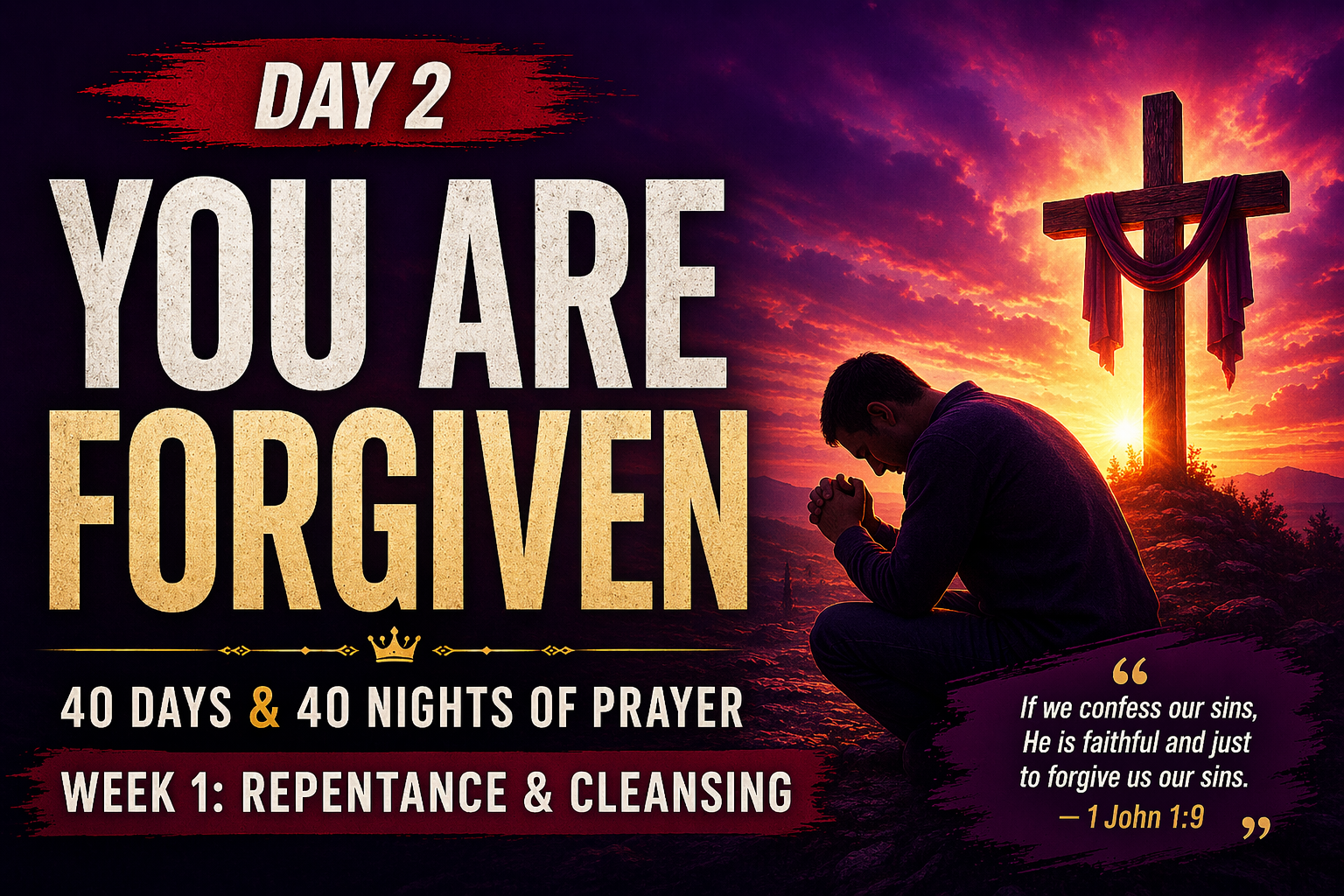
.ssim{font-family:Georgia,serif;color:#1A1A1A;line-height:1.85;max-width:860px;margin:0 auto;padding:0 20px} .sh{background:#2A0A3A;padding:28px 24p
40 Days & 40 Nights of Prayer · Soul Salvation International Ministries
Week 1 · Repentance & Cleansing
FORGIVENESS OF SINS
📖 KEY SCRIPTURE
✝️ INTRODUCTION
Yesterday we returned to God. Today we must deal with what kept us away — sin. The word ‘forgiveness’ in the New Testament Greek is ‘aphiemi’ — to send away, to release, to dismiss completely. God does not manage our sins. He does not file them away for future reference. He sends them away — as far as the east is from the west, which is an infinite distance because east and west never meet. This is the radical, scandalous, history-altering truth of the Gospel: God forgives completely.
Yet many believers live in a state of perpetual spiritual guilt — not because God has not forgiven them, but because they have not received the forgiveness He has already granted. They confess the same sins repeatedly, afraid that the forgiveness did not take. They carry a spiritual weight that Jesus already bore at Calvary. Today we dismantle the theology of incomplete forgiveness and receive the full, free, finished forgiveness of God.
SENT AWAY
What God Does With Your Sins When You Confess
1. What Sin Does to the Soul
David wrote Psalm 32 out of the agony of unconfessed sin. For a season after his adultery with Bathsheba and the murder of Uriah, he tried to maintain the silence. And the silence was destroying him. Psalm 32:3–4 captures the physical, emotional, and spiritual devastation of unconfessed sin with painful honesty: ‘When I kept silent, my bones grew old through my groaning all the day long. For day and night Your hand was heavy upon me; my vitality was turned into the drought of summer.’
Unconfessed sin produces a heaviness that touches every dimension of human life. Sleep becomes elusive. Joy evacuates. Relationships become strained because the hidden guilt leaks out as irritability, defensiveness, and emotional withdrawal. The spiritual life flatlines — prayer feels hollow, worship feels like hypocrisy, and the Word of God that once fed the soul now reads as accusation.
2. The Three Hebrew Words for Sin
Scripture uses three primary Hebrew words that are all translated ‘sin’ in English, but each captures a different dimension of wrongdoing before God — and understanding them deepens both our confession and our gratitude for forgiveness.
⚠️ CHATA: To miss the mark — to fall short of God’s standard of holiness. This is sin as failure, as inadequacy, as the gap between what we are and what God designed us to be. Romans 3:23: ‘For all have sinned and fall short of the glory of God.’
🔨 AVON: Iniquity — twisted, bent, crooked. This describes the distortion of character that sin produces over time. Not just individual acts of sin but the bent nature, the habitual lean toward evil, the warped perspective of a heart that has made repeated sinful choices.
⚔️ PESHA: Transgression — willful rebellion, a deliberate crossing of a known boundary. This is the most serious category — sin done with full knowledge and intentional defiance. Yet even this — PESHA — is sent away in the forgiveness of God.
Psalm 51 — the great penitential psalm — uses all three words: ‘Have mercy upon me according to Your lovingkindness… Blot out my transgressions (PESHA). Wash me thoroughly from my iniquity (AVON), and cleanse me from my sin (CHATA).’ David covers the full spectrum of sin in his confession. And God’s forgiveness covers the full spectrum.
3. The Foundation of Forgiveness
Forgiveness is not God looking the other way. It is not God lowering His standards out of sentimental love. Forgiveness is costly — it required the death of the Son of God. Hebrews 9:22 establishes the non-negotiable principle of the entire sacrificial system: ‘Without shedding of blood there is no remission.’ The word ‘remission’ is the same Greek word as ‘forgiveness’ — aphiemi — to send away. Sin cannot be sent away without blood being shed. This is not arbitrary cruelty. It is the profound moral logic of a universe governed by a holy God: sin has consequences, and someone must bear them.
The entire Old Testament sacrificial system was a centuries-long sermon pointing to one moment: the Lamb of God taking away the sin of the world (John 1:29). Every bull and goat that was slain on the altar of Israel was a promissory note pointing forward to the ultimate payment. When Jesus cried ‘It is finished’ (John 19:30) — the Greek ‘tetelestai’ was the word stamped on paid commercial debts in the ancient world — He was declaring that the debt of sin was paid in full, permanently, for all who would receive it.
4. The Mechanics of Confession
First John 1:9 contains one of the most important conditional promises in all of Scripture: ‘If we confess our sins, He is faithful and just to forgive us.’ The word ‘confess’ — ‘homologeō’ in the Greek — literally means ‘to say the same thing.’ To confess sin is to agree with God about it — to call it what He calls it, to see it the way He sees it, without minimizing, qualifying, or redirecting the blame.
Genuine confession is not vague religiosity (‘Lord, forgive me if I’ve done anything wrong’). It is specific, honest agreement with God about specific, known sin. It is the posture of 1 John 1:9 — ‘if we confess’ — paired with the assurance that follows: ‘He is faithful and just to forgive.’ Note that forgiveness here is rooted not in God’s mercy alone but in His faithfulness and justice. Because Jesus already bore the punishment for that sin, it would be unjust of God NOT to forgive the confessing believer. The cross demands the forgiveness.
5. The Distance of Forgiveness
Psalm 103:12 uses the most profound spatial image in Scripture to describe the completeness of God’s forgiveness: ‘As far as the east is from the west, so far has He removed our transgressions from us.’ East and west are the only two directions on a compass that have no meeting point — if you travel north long enough, you will eventually reach the south pole and begin traveling south. But east and west never converge. They are infinite in their separation.
This is the deliberate poetry of the Holy Spirit. God did not say ‘as far as the north is from the south’ — because north and south have definable poles, measurable distances. He chose east and west — the infinite, unmeasurable directions — to describe the completeness of His removal of your sins. They are not merely covered. They are not in a file marked ‘forgiven but not forgotten.’ They are GONE — infinitely, irreversibly, permanently removed.
6. The Freedom Forgiveness Gives
Micah 7:19 adds another stunning image: ‘You will cast all our sins into the depths of the sea.’ The ‘depths of the sea’ in the ancient mind represented the most inaccessible, most unreachable, most permanent disposal available. What goes to the depths of the sea does not come back. And — as Corrie ten Boom famously said — God puts up a sign that reads: ‘No fishing.’
The freedom that complete forgiveness gives is the freedom to stop carrying what God has already removed. Many believers have confessed their sins but are still hauling them through their daily lives like a ball and chain. They confess and then retrieve. They repent and then rehearse. This is not the freedom God intends. ‘There is therefore now no condemnation to those who are in Christ Jesus’ (Romans 8:1). ‘Now’ — present tense, immediate, currently in force.
🙏 ALTAR CALL
Today is the day to lay down what you have been carrying. Not just the sin — but the guilt, the shame, the self-punishment, the sense that you are too dirty to be fully forgiven or too far gone to be fully restored. All of it is addressed at the cross.
The blood of Jesus is not inadequate. The forgiveness of God is not incomplete. The faithfulness of God is not conditional on the severity of your sin. ‘Though your sins are like scarlet, they shall be as white as snow’ (Isaiah 1:18). Scarlet was the deepest, most permanent dye known in the ancient world. White wool was the purest, most unstained. God is saying: no matter how deep the stain of your sin — His forgiveness goes deeper.
Confess specifically. Receive completely. Walk free.
🔥 DAY 2 PRAYER FOCUS
📜 Specific Confession
Father, I come before You now with specific confession. [Pause here and confess specifically before God.] I agree with You about my sin — I call it what You call it. I do not minimize, excuse, or redirect. I confess and I forsake. Thank You that Your faithfulness and justice demand my forgiveness because Jesus has already paid. In Jesus’ name, Amen.
🩸 Receiving the Blood
Lord Jesus, I receive the full application of Your blood to every sin I have confessed and every sin I have forgotten. Your blood is sufficient — not partially sufficient, not conditionally sufficient, but FULLY sufficient for the complete removal of every sin in my life. I am washed. I am clean. In Jesus’ name, Amen.
⛓️ Breaking the Power of Guilt
Holy Spirit, I renounce the spirit of condemnation that has kept me in spiritual guilt long after God’s forgiveness was received. I declare Romans 8:1 over my life: there is NOW no condemnation. I refuse to carry what God has already removed. Guilt’s voice is silenced by the blood. In Jesus’ name, Amen.
🌊 Forgiveness Extended to Others
Father, as I receive Your forgiveness, I choose to extend forgiveness to those who have sinned against me. I release [name them before God]. I will not hold what God has released. Forgive through me what I could never forgive on my own. In Jesus’ name, Amen.
⚡ DECLARATION — DAY 2
I DECLARE: I am FORGIVEN — completely, permanently, and unconditionally — by the blood of Jesus Christ. My sins are as far as the east is from the west. They are cast into the depths of the sea. There is NO condemnation over my life. I walk today in the freedom of a fully forgiven child of God. In Jesus’ name — AMEN!
📝 REFLECTION QUESTIONS
🔍 Specificity: What specific sin or sins have you been confessing in vague, general terms that God is calling you to name specifically today?
💭 Hidden Guilt: Are you still carrying guilt over something God has already forgiven? What would it mean practically to stop retrieving what God has removed?
🤝 Extending Forgiveness: Is there someone whose sin against you you have been withholding forgiveness from? How does receiving God’s radical forgiveness change your capacity to forgive them?
See you on Day 3 — Cleansing by the Blood
